BEST MOTORCYCLE SHOP IN CENTRAL FLORIDA
WE DO NOT CLAIM TO BE THE CHEAPEST, BUT WE AIM TO OFFER THE BEST SERVICE TO SATISFY OUR CUSTOMERS


Triumph Rocket III
A 2.5-Liter Giant, Re-Engineered
The Rocket III is already an engineering statement: 2,458 cc of inline-three torque, massive pistons swinging on a long crankshaft, and enough stock torque to twist a chassis under throttle. But this build wasn’t about “enough.” It was about transforming a muscle bike into a forced-induction engineering exercise.
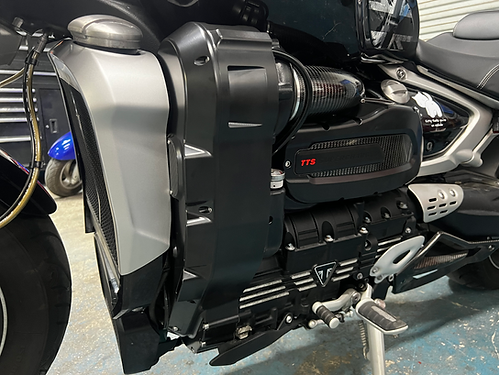
The crate from TTS Performance arrived with the core of the transformation: a Rotrex C30-94 centrifugal supercharger, bespoke CNC-machined mounting brackets, billet plenum, drive pulleys, belt system—and internally, forged pistons and dedicated camshafts designed specifically for boosted operation. This wasn’t a bolt-on cosmetic kit. It was a structural rethink of how the Rocket breathes, compresses, and delivers power.

TTS Supercharger Kit for Triumph Rocket III
Kit Purpose:
TTS Performance’s package is a centrifugal supercharger conversion designed to dramatically increase power on the Triumph Rocket 3 platform. It uses a Rotrex centrifugal supercharger system engineered specifically for this engine, delivering extremely high power levels while maintaining linear throttle response and low-lag performance typical of Rotrex units.
Typical Output:
-
Up to ~300+ bhp at the rear wheel in the “Rocket 300” spec.
-
Some builds dyno over 340 bhp and ~270 lb-ft torque evidence from independent tests of a TTS Rocket 300 conversion.
Core Components:
-
Rotrex C30-94 centrifugal supercharger — compact, high-efficiency rotor assembly.
-
Custom CNC-machined housing and inlet plenum, often billet aluminium with carbon-fiber trim.
-
Oil cooler / reservoir integration for the Rotrex unit.
-
Supercharger crank drive bracket & pulley system.
-
Boost plumbing, hoses, fittings, and mounts.
-
Base ECU map and instructions.
-
Optionally uprated forged JE pistons, TTS camshafts, heavy-duty studs, clutch upgrades, etc.
Engineering Notes:
-
Rotrex centrifugal units produce smooth, linear boost with minimal lag due to direct belt drive and high impeller speeds.
-
The kit is bespoke machined for each application and is made to order at TTS’s Silverstone facility.


The Tear-Down
The project began methodically.
Bodywork off. Tank removed. Radiator and cooling circuit drained and pulled. Airbox and throttle assemblies set aside. The front of the engine was exposed, and with it, the mechanical heart of the 2.5-liter triple.


The forged pistons were installed with correct ring orientation and end-gap verified for forced-induction duty. Under boost, ring seal and thermal management are critical. Clearances that work on a naturally aspirated motor often fail when cylinder pressures spike.


With cylinder one locked at true TDC, timing marks were verified and documented. No assumptions. On a boosted build, cam phasing errors aren’t minor—they’re catastrophic. The cam chain tensioner came out, cam caps removed in sequence, and the top end was stripped down to accept new internals.


Degreeing the Cams
The aftermarket camshafts weren’t simply installed—they were degreed.
A degree wheel mounted to the crank. Dial indicator on the valve. The intake and exhaust centerlines were measured and adjusted precisely. With boost in the equation, overlap strategy changes. Too much overlap and you push charge out the exhaust. Too little and you choke flow at higher RPM.
This step transformed the engine from “assembled” to “calibrated.”
Cam timing was set deliberately to balance mid-range torque and high-RPM airflow under boost. Once verified, fasteners were torqued to specification with thread locker where required. No shortcuts.